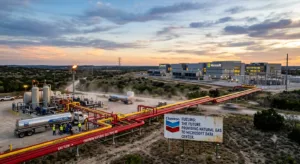
The 20-year power purchase agreement between Chevron and Microsoft marks a massive pivot in how Big Tech is planning to fuel the explosive growth of artificial intelligence.
Here is a breakdown of the key details from the landmark deal:
The Core Details: Project Kilby
-
The Scale: The project—named Project Kilby—is a planned 2.67-gigawatt data center campus and co-located power plant. At full build-out, its energy capacity will be equivalent to the electricity needs of roughly 2 million homes.
-
The Location: Spanning over 2,000 acres, the massive complex will be built in Reeves County, West Texas (near the city of Pecos).
-
Timeline & Cost: First power is expected to flow to the data center in 2028, with development continuing through the 2030s. While official costs haven’t been disclosed, industry insiders estimate the total project cost at around $7 billion.
Bypassing the Grid (Behind-the-Meter)
A critical feature of Project Kilby is that it will be a “behind-the-meter” facility. Instead of pulling power from ERCOT (Texas’s heavily stressed regional grid) or waiting years in an interconnection queue, the data center will be plugged directly into a brand-new, on-site natural gas power plant.
Chevron and investment firm Engine No. 1 will oversee the power infrastructure, utilizing large-scale gas turbines provided by GE Vernova and Caterpillar.
Why Natural Gas, and Why Now?
The deal highlights a reality for hyperscalers: the AI boom requires immense, uninterrupted, 24/7 power that intermittent renewable sources like solar and wind struggle to guarantee on their own. While Microsoft has historically prioritized renewables and recently backed nuclear options (such as the deal to revive Pennsylvania’s Three Mile Island), this partnership shows a willingness to lean into fossil fuels to scale quickly.
Furthermore, the Permian Basin routinely produces more natural gas than regional pipelines can actually carry away. This excess supply frequently gluts the local market and depresses prices. By building the power plant directly over these abundant reserves, Chevron can monetize its excess gas, providing Microsoft with a massive, highly competitive cost advantage.
Economic and Environmental Impact
Chevron projects that the development will generate more than $10 billion in state and local tax revenue and support nearly 2,000 regional jobs.
However, the deal has drawn scrutiny from environmental advocates. Locking a massive AI data center hub into a 20-year fossil fuel contract directly challenges the tech sector’s ambitious net-zero and carbon-negative sustainability targets. Chevron, meanwhile, has stated that it plans to replicate this exact “power-and-compute” model at multiple other sites across the United States where it holds domestic energy assets.