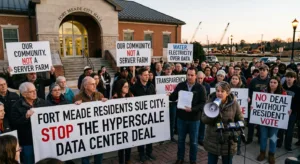
The battle over the proposed $2.6 billion, 4.4 million-square-foot hyperscale data center in Fort Meade has rapidly escalated from tense city hall meetings into a high-stakes legal and political showdown.
After the Fort Meade City Commission unanimously approved a development agreement with Maryland-based developer Stonebridge (operating as Florida Ecopark LLC) in April 2026, local opposition mobilized. Backed by national environmental advocacy groups like Earthjustice and Food & Water Watch, residents formed “Watchdogs of Fort Meade” to challenge the deal in court.
The legal and regulatory pushback focuses on several critical fronts:
1. The Water Supply Clash
Water usage has become the project’s biggest hurdle. While the developer claims a closed-loop cooling system has brought projected water needs down to 50,000 gallons per day, state officials and regulators are pushing back hard:
-
The State’s Warning: Florida Commerce Secretary Alex Kelly issued a sharply worded letter calling the developer’s water estimates “woefully underestimated” and “plainly misrepresented” for a facility of this magnitude.
-
Infrastructure Blocked: The Southwest Florida Water Management District (SWFMD) notified Fort Meade that it cannot use the city’s existing water infrastructure to supply the center. The developer must apply for an entirely new, separate water permit, which requires a highly scrutinized public vote by the SWFMD governing board.
2. Quality of Life & Economic Realities
The lawsuit and resident opposition highlight a deep mismatch between the massive scale of the facility and Fort Meade’s rural identity:
-
Infrastructure vs. Character: Residents argue that the 1,300-acre project—sited on a former phosphate mine just west of U.S. 98—introduces heavy industrial infrastructure, massive electrical substations, and persistent low-frequency hums that are entirely incompatible with the local neighborhood.
-
The “Job” Disconnect: While proponents point to long-term economic revenue and temporary construction work, residents note that the facility is projected to create fewer than 150 to 500 permanent jobs by 2031, despite receiving $140 million in tax incentives approved by Polk County over ten years.
-
Transparency Issues: State officials and residents have both raised flags over the fact that the actual “end-user” (the tech giant that will ultimately operate the data center) remains completely undisclosed.
What Lies Ahead
Because the City Commission’s approval of the development agreement was just the first step, the project faces an uphill battle. To break ground, Stonebridge still needs to clear multiple hurdles that are now prime targets for legal intervention, including:
-
Overcoming the SWFMD water permit restrictions.
-
Securing environmental clearances from the Florida Fish and Wildlife Conservation Commission (FWC).
-
Navigating a growing wave of anti-data-center sentiment across Florida, which has already prompted nearby counties like Lake, Pasco, and Nassau to propose or enact moratoriums on similar large-load projects.