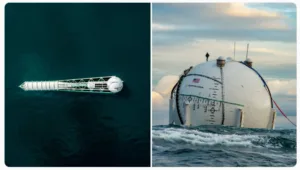
Driven by the massive electricity demand of the artificial intelligence boom, a wave of innovation is shifting away from land-based grids and looking directly to the open ocean. A prominent US-based startup, Panthalassa, is pioneering this shift by developing self-sustained, floating data centers that generate their own power using ocean wave energy and utilize seawater for cooling.
Backed by a recent $140 million funding round that valued the public-benefit corporation at over $1 billion, Panthalassa’s approach addresses two of the biggest bottlenecks facing terrestrial data centers: extreme power consumption and community resistance to land and water use.
How It Works: The “Floating Hydroelectric Dam”
Panthalassa’s hardware consists of massive, un-tethered floating structures called nodes. Instead of being anchored to the seafloor or tethered to a land-based power grid by expensive underwater cables, these nodes operate autonomously in the deep ocean where wave energy is at its peak.
-
Wave-Driven Power: Each node features a large spherical top (roughly 50 meters in diameter) sitting on a neck that extends 60 to 70 meters below the surface. As ocean waves move the structure up and down, water is forced upward through the neck and into a pressurized reservoir inside the sphere. The water then discharges through an internal turbine, creating continuous electricity.
-
Onboard Edge Compute: The generated electricity directly powers high-density AI server hardware installed inside the node.
-
Satellite Connectivity: Because no physical cables are running back to shore, data and AI processing tasks are transmitted to and from the floating data centers via Low Earth Orbit (LEO) satellite constellations.
-
Zero-Emission Cooling: Operating at sea allows the data center to use surrounding ocean water for cooling, completely eliminating the demand for land-based freshwater resources.
Why the Tech is Shifting to the Open Ocean
Wave energy has historically struggled to achieve commercial viability because transmitting electricity from far offshore back to coastal land grids is incredibly inefficient and expensive. By co-locating the data centers on the power source, companies bypass the terrestrial power grid entirely.
Key Advantages over Land-Based Infrastructure:
-
Bypassing Grid Congestion: AI data centers are facing long delays for grid connection approvals on land. Floating nodes can be manufactured in facilities and deployed rapidly at sea.
-
Eliminating Land & Resource Conflicts: This model circumvents growing public pushback regarding data center land use, noise pollution, and heavy consumption of local water utilities.
-
High Scalability: Multiple autonomous nodes can be deployed together to act as a singular, distributed, modular data center network.
A Parallel Track: Coastal Wave Energy
While Panthalassa focuses on deep-ocean autonomous nodes, companies like Eco Wave Power are tackling the energy crisis from the coastline. In collaboration with partners like Shell and the Port of Los Angeles, Eco Wave Power uses stationary floaters attached to existing marine infrastructure (like breakwaters and sea walls) to capture wave energy. They use land-based computing and digital twin technology to align heavy AI processing workloads with periods of high wave activity.
Panthalassa’s newest autonomous prototypes, the Ocean-3 nodes, are currently under construction and scheduled for sea deployment around August 2026.