Listen to The Challenger Legacy to find out why Artemis is “Apollo on steroids”.
NASA has experienced issues with heat shields before. In 2003, the Columbia space shuttle broke apart on re-entry, killing all seven crew on board.
Investigations found the cause of the disaster was due to damage from a foam strike during launch that pierced the shuttle’s heat shield.
In January, NASA’s administrator, Jared Isaacman, told reporters that he had “full confidence in the Orion spacecraft and its heat shield”.
But Dr. Camarda is not convinced.
“I lost three classmates and seven friends on Columbia … I don’t want to see another crew lost.”
And he is not the only person in the space community with concerns.
A heat shield is a thick layer on the bottom of the spacecraft built to withstand temperatures of about 3,000 degrees Celsius that occur on re-entry.
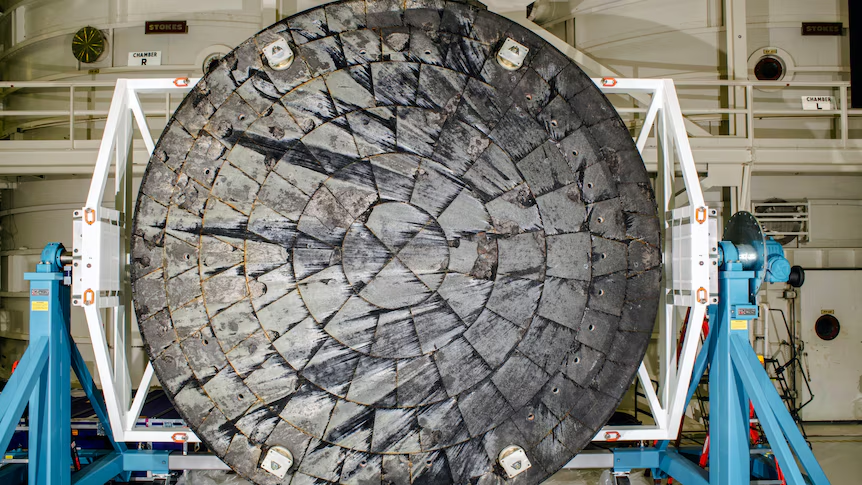
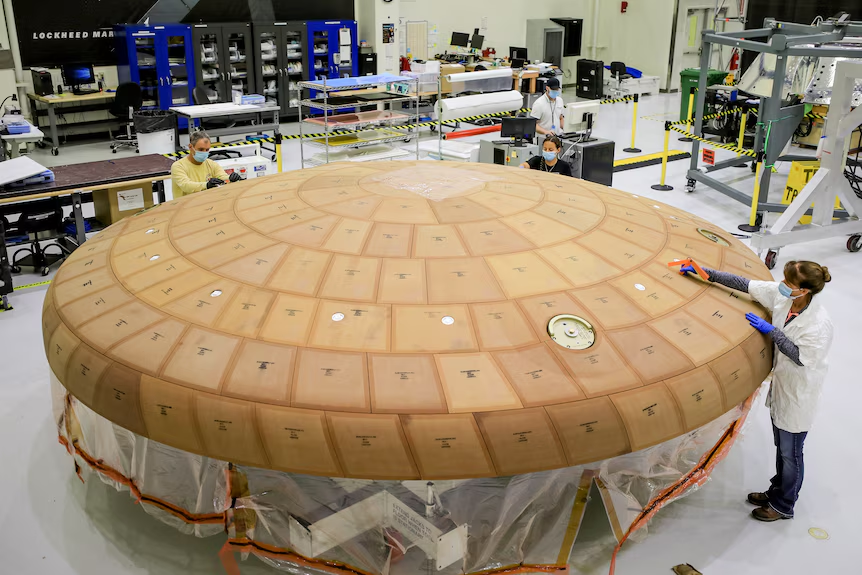
Orion’s heat shield is made up of 186 blocks of a material called Avcoat, which protects the spacecraft as it heats up and burns in a controlled way to avoid the area underneath it getting too hot.
Similar technology was first used in the Apollo missions in the 1960s and 70s, and because of this, NASA engineers were confident they would know how the material would act.
In November 2022, during the first Artemis mission that travelled around the Moon, the spacecraft was put through its paces using test dummies instead of humans.
But the heat shield experienced unexpected damage, said Wendy Whitman Cobb, space policy expert at the School of Advanced Air and Space Studies in Alabama.
Since Artemis I, NASA has conducted intense heat testing on the ground. However, Artemis II will be the first time the Orion spacecraft has flown since the heat shield issues emerged.
What happened to Orion’s heat shields in Artemis I?
NASA engineers found more than a hundred cracks and craters on the surface of Orion’s heat shield when the Artemis I mission landed.
“When Orion came back through the atmosphere … it was coming back at a very high rate of speed,” Dr Whitman Cobb said.
“In order to burn off some of that speed, they did a skip manoeuvre … at a shallow angle, so that Orion skipped off the atmosphere.”
Despite the damaged heat shield, the spacecraft itself was not affected.
“The entire system had sensors everywhere. If astronauts had been aboard, they would have been fine,” she said.
But it was surprising, as this type of damage had not been seen in neither the Apollo missions nor an exploratory test done in 2014.
NASA investigated the issue and released a report in May 2024, a year and a half after the Artemis I mission.
The report suggested that changing the way Artemis II re-entered the atmosphere would fix the problem — instead of doing a “double bounce” maneuver to try to slow down, Artemis II would enter the atmosphere directly.
The idea was that this would reduce the time the heat shield needed to be exposed to the extremely hot atmospheric temperatures, leading to less cracking and damage under the surface.
Mr. Isaacman said his confidence about the heat shield’s performance was “grounded in rigorous analysis and the work of exceptional engineers who followed the data throughout the process”.
But worries about the heat shield have not gone away.
Dr. Camarda said he was extremely concerned when he saw the NASA report.
“The heat shield on the belly of the vehicle … has to absorb all that heat,” he said.
While the Avcoat material is very similar to the one used in the Apollo missions, it has been reformulated slightly for Artemis. This is partially due to having to re-engineer the technology, and partially to meet environmental legislation outlawing certain compounds.
The other change is the way the Avcoat has been applied.
In the Apollo missions, one large piece of Avcoat was used throughout the bottom of the spacecraft, but in the Artemis I and II missions, the heat shield is made up of more than 186 blocks or tiles.
“It’s got a major inherent problem … a structural problem, and they do not understand the physics of that problem,” Dr. Camarda said.
“[NASA] claimed success [with Artemis I], but I look at that as a major failure.”
Ed Pope, an advanced materials expert and a heat shield engineer, also shared his concerns on LinkedIn last year.
He said NASA “dithered with a committee” and “not-so-relevant testing” instead of fixing the heat shield.
“They made a huge mistake with the approach to manufacturing the heat shield,” Dr. Pope said.
“Unfortunately, it’ll now take too long, cost too much, and cause too great of a delay if they fix it … Expediency won over safety and good materials science and engineering.”
Artemis II crew members include the first woman, the first person of colour, and the first Canadian Space Agency astronaut to fly to the Moon. (Supplied: NASA)
Unlike Artemis I, this will be the first time that humans will be onboard.
Despite concerns by Dr. Camarda and Dr. Pope, Mr. Isaacman said “crew safety remains our foremost priority at NASA” in a social media post in January.

All four of the astronauts have also expressed confidence in the heat shield.
“At the end of the day, I know they are thinking about us and our families,” Christina Koch, one of the mission specialists, told reporters.
NASA did not respond to a request for comment by the deadline.
Both cost and delay were given as reasons for not updating the heat shield design for Artemis II.
However, NASA has confirmed that Artemis III, which will launch later this decade, will have an updated design.