By Bob Garver
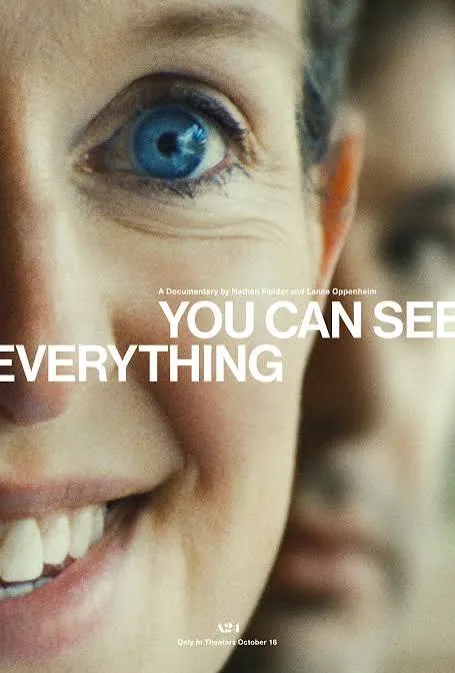
Unlikely box office hit “You Can See Everything” is a nearly three-hour documentary from comedic filmmaker Nathan Fielder. The movie follows disgraced Theranos founder Elizabeth Holmes, famously played by Amanda Seyfried in the Hulu series “The Dropout.” Essentially, Holmes defrauded investors by claiming to have breakthrough blood-testing technology that ultimately did not work properly. With an 11-year prison sentence looming, Holmes and her partner Billy Evans invited Fielder and his crew to live in their home and document their last month together for the foreseeable future.
The first part of the movie follows Holmes, as expected. Elizabeth and Billy are eccentric, but they play up relatable traits like loving their children and enjoying walks on the beach. There’s a strong whiff of the couple trying to “control the narrative” and get the audience on their side, especially during a frustrating sequence where they go over the exact verbiage that Elizabeth used in interviews and presentations. They want the audience to believe that Elizabeth isn’t guilty of the crimes that are sending her to prison, or at least that she didn’t know she was committing crimes. Fielder doesn’t know what to make of these claims, since clearly the couple is behaving performatively to some degree, but there appear to be some limits to Elizabeth’s mental capacity that make her untruths seem less deliberate. Either way, no appeals to the documentary are going to get Elizabeth off the hook. She goes to prison, she’s in prison at the end of this movie, and she’s still in prison as of this writing.
But the movie doesn’t end with Elizabeth going to prison. It “implies” that it’s going to end there, but it has some more tricks up its sleeve. Fielder starts thinking that Billy isn’t on the level, that he’s misrepresenting Elizabeth on social media in her absence and trying to hone in on her business ventures. It’s at this point that Fielder enlists the help of an unlikely ally that I’ll call “The 4th Party.”
The 4th Party takes an interest in stopping Billy’s scheming, going so far as to confront him at his own dinner table. They also serve as an interaction partner for Fielder, sometimes agreeing with him and sometimes providing their own opinions that counter his takes. Because scenes between Fielder and The 4th Party seem staged and therefore scripted, sometimes I think The 4th Party isn’t providing their own opinions, but just saying what Fielder wants them to say as a stand-in for his conscience. It’s certainly an interesting way of sharing his inner struggles with the audience, but there’s an unshakeable disingenuousness to it.
Both parts of the movie are compelling in their own way. If you’re looking for insight into Holmes herself, with her unique way of thinking (the word “autistic” is never used, but she displays several classic symptoms, including not understanding the humor in a famous comedy routine), then the first half is for you. Then again, it will be up to you to decide if the version of her personality that she presents to the camera is her honest self, or – and the movie keeps coming back to this phrase – “a character she created.”
It’s the second part though, the one that takes more risks creatively, that has made the film a breakout hit. Yes, there’s the deliberate staging between Fielder and The 4th Party, and there’s an undeniable self-indulgence to Fielder making the movie more about himself than supposed subject Holmes, but the last minute of the movie sees many pieces of a puzzle that nobody was working to solve fall unexpectedly into place. It’s the kind of ending that may inspire viewers to see the film all over again (no small feat given the film’s length) so they can revel in details they missed the first time. For now, I’ll just say that you should see “You Can See Everything” at least a first time.
Grade: B-
“You Can See Everything” is rated R for language and some graphic nudity. Its running time is 174 minutes.