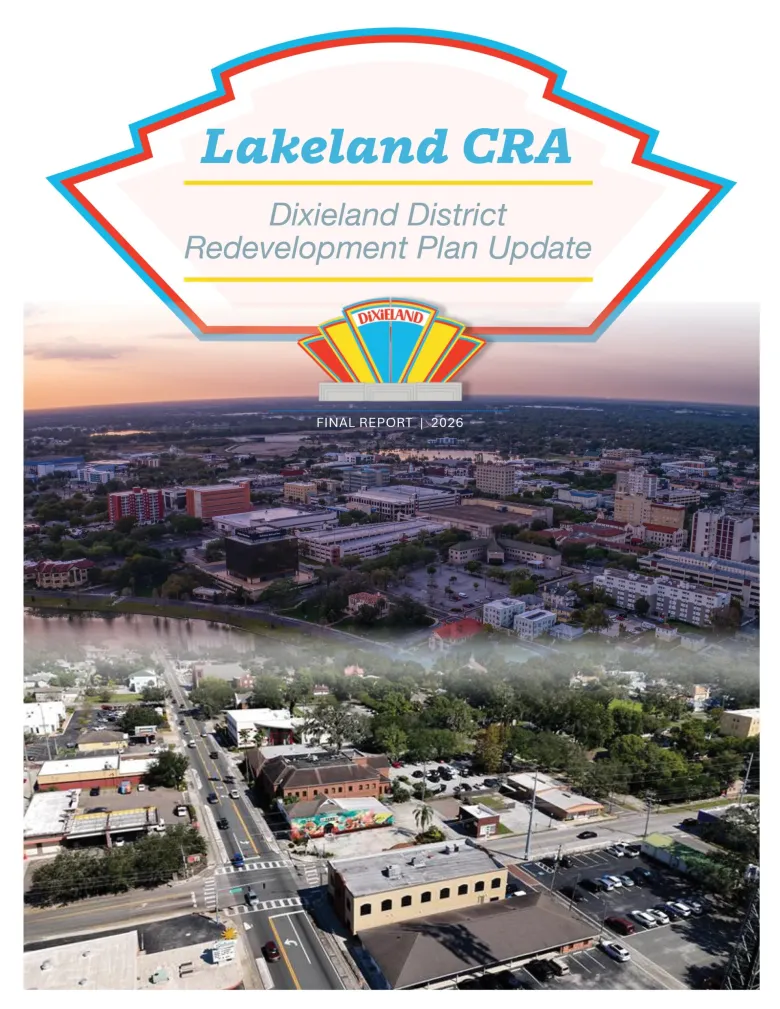
The 113-page “Restore the Core” plan, presented to the Lakeland CRA advisory board on May 7, 2026, signals a significant pivot for Dixieland. While previous efforts focused on historic preservation and storefronts along South Florida Avenue, this new vision reclassifies the neighborhood’s alleys from “service corridors” to essential “social and transit links.”
Here is a breakdown of how the vision for Dixieland’s alleys and connectivity is evolving:
Alleys as “Activated” Spaces
The plan proposes transforming these overlooked corridors into pedestrian-friendly assets. Instead of just being routes for trash collection or shortcuts, the “activated” alleys are envisioned as:
- Art Corridors: Designated spaces for murals and local installations.
- Social Links: Gathering spaces that connect restaurants, coffeehouses, and vintage shops.
- Pedestrian Pathways: Improved lighting, landscaping, and signage to encourage walking and biking between blocks without relying on the main thoroughfare.
Priority Shifting: Beyond Beautification
The updated plan replaces the 2001 blueprint, reflecting Lakeland’s growth from 85,000 to nearly 130,000 residents. The CRA’s proposed budget allocation reflects this move toward functional infrastructure:
- 31% Streetscape improvements
- 29% Public parking solutions
- 20% Business recruitment and incentives
- 20% Historic preservation
Connectivity & Public Transit
The vision leans heavily on creating a cohesive “walkable” network. Key recommendations include:
- The Squeeze Expansion: Proposals for free shuttle service to better connect Dixieland residents and visitors to Downtown.
- Safer Crossings: Addressing the 68% of survey respondents who prioritized sidewalk repairs and safer pedestrian crossings.
- Traffic Calming: Implementing measures to slow vehicles and prioritize the “shop-ability” of the district.
Timeline for Implementation
The project is categorized into three phases to manage the 17 identified priority projects:
- Short-term: Projects beginning within 3 years.
- Medium-term: Priorities taking 4 to 7 years.
- Long-term: Goals projected beyond 7 years.
This shift suggests that Dixieland is being treated less as a drive-through corridor and more as an integrated urban hub, where the “back of house” alleys become the “front door” for community interaction.