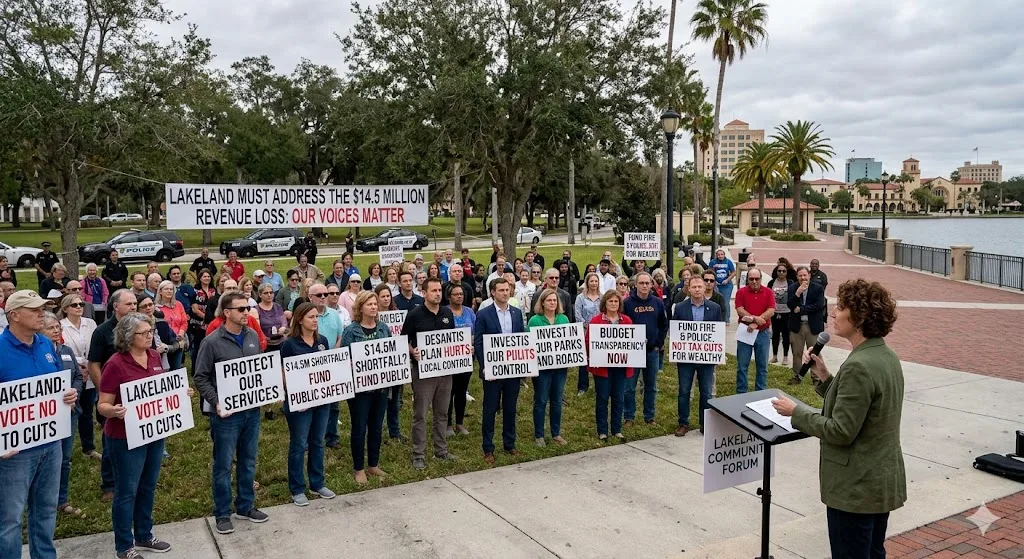
If the City of Lakeland faces a major $14.5 million revenue deficit due to the sweeping state-level property tax overhauls—such as Governor DeSantis’ proposed $250,000 homestead exemption expansion—the Lakeland City Commission will have to make tough, immediate fiscal choices.
Because property taxes account for roughly 32% ($58.1 million) of Lakeland’s General Fund, a $14.5 million loss represents a massive 25% drop in that core revenue source. Municipalities have a limited, distinct set of options to balance the budget when a hit of this scale occurs.
1. Re-evaluate Public Safety Spending
Public safety makes up nearly half of Lakeland’s General Fund expenditures. In recent budgets, the city allocated over $60 million to the Lakeland Police Department and nearly $30 million to the Lakeland Fire Department.
- The Reality: It is mathematically impossible to absorb a multi-million dollar cut without looking at these two departments.
- The Impact: While city leaders heavily resist cutting emergency services, a loss this large could force hiring freezes, delays in purchasing police cruisers, or slowing down expansions like the staffing of newer fire stations.
2. Tap Into the Surplus (Short-Term Buffer)
Lakeland historically maintains a healthy starting internal surplus (often hovering around $50 million) within its unassigned General Fund reserves.
- The Reality: While the commission can use these reserve funds to patch the deficit for a fiscal year or two, it is a temporary band-aid.
- The Impact: Using reserves to cover recurring operational shortfalls drains the city’s emergency rainy-day funds, leaving Lakeland vulnerable to economic downturns or major hurricane recovery costs.
3. Defer Infrastructure and Quality-of-Life Projects
When revenue drops, non-essential projects and discretionary capital improvements are the first items on the chopping block.
- The Reality: The city spending on road maintenance, park upgrades, and community initiatives would be scaled back.
- The Impact: Matching grants—like those previously discussed for local community structures (e.g., the Police Athletic League or local arts councils)—would likely be paused or canceled. Street resurfacing and sidewalk expansions would face significant delays.
4. Optimize the “Utility Dividend”
Lakeland is unique because it owns its municipal utility, Lakeland Electric. The utility pays a dividend—essentially a payment in lieu of taxes (PILOT)—directly into the city’s General Fund, which usually brings in more than $46 million annually.
- The Reality: The City Commission could pressure the utility to increase its dividend to cover the property tax shortfall.
- The Impact: Forcing a higher payout from Lakeland Electric reduces the utility’s own cash reserves for infrastructure maintenance or grid upgrades. This could indirectly result in higher electric utility rates for local residents, shifting the financial burden from property taxes to utility bills.
5. Explore New Local Fees
To protect core services without raising the property millage rate (which would be restricted or rendered less effective by the state plan), cities often look to alternative revenue tools.
- The Reality: Lakeland could implement or raise specific user fees.
- The Impact: This could include introducing stormwater utility fees, increasing fire protection assessment fees, or raising public park and recreation programming costs to make those services entirely self-sustaining.
Florida property tax proposal draws early scrutiny ahead of special session This news report outlines the statewide tensions and municipal anxieties surrounding the legislative push to heavily expand property tax exemptions, which threatens local government funding across Florida.
A “massive 25% drop in that core revenue source” actually only accounts for an 8% decrease in total, as that funding source only makes up 32% of the revenue.
Do you believe the city runs so efficiently that there is not 8% waste that can be trimmed?