“The Crooked E.” Theranos. WorldCom. Sam Bankman-Fried. The 2008 housing/financial crisis. Those are examples of massive frauds and/or systemic failures hiding in plain sight for years in the ‘information age.’ Regardless of which of the two major political parties were in power in Washington, D.C., how was evidence of this or that looming crisis often downplayed by the leadership of federal regulatory agencies until the problems became too big to ignore? When citizens think about data centers, artificial intelligence (AI), and regulation, we should not be naïve. Regulators can and do fail.
“…regulatory bodies, like the people who comprise them…become with some exceptions, either an arm of the industry they are regulating or senile.” So said John Kenneth Galbraith.
Business professional and bestselling author Carol Roth has been featured on CNN and Fox News. Per Roth: “…all regulation…excessively impacts small business…In fact, big companies secretly love regulation because regulations are in fact anti-competitive — every new rule, law or compliance measure limits the ability of existing smaller competitors or new start-ups to compete. While big businesses can use their caches of cash to fund new people and procedures to deal with regulation, for many small businesses, a new regulation can put them out of business.”
In the prior Gazette news analysis here, thinking readers were introduced to how the Iron Triangle operates in the affordable housing market that includes, but isn’t limited to, modern manufactured homes. Per Gemini: “AmeRegCorp (n.): The symbiotic consolidation of American regulatory agencies and dominant corporate entities, resulting in a market structure that favors established players while suppressing independent competition through legislative and financial bottlenecks.” Terms like the “revolving door” and the “follow the money” method are necessary for understanding how, regardless of whether Democrats or Republicans are in power in Washington, many dynamics can more or less stay the same.
That doesn’t mean there aren’t changes, or differences, between the parties. There are. But it means the donor class, those who provide cash fueling campaigns, influences the political process.
When someone follows advertiser influence over major media, the powerful lessons from Shadows of Liberty come into focus. That docu-drama remains relevant, and the full-length version of Shadows with annotated transcript here is worth the 90-minute investment. Shadows entertains and informs.
From Shadows, media professor Deepa Kumar said: “Giant media corporations like Time Warner and News Corporation, Disney and so forth, they get to decide what is news.”
“These large conglomerate companies decide on their own and for their own purposes the news we see and hear,” said Dan Rather, former CBS News anchor.
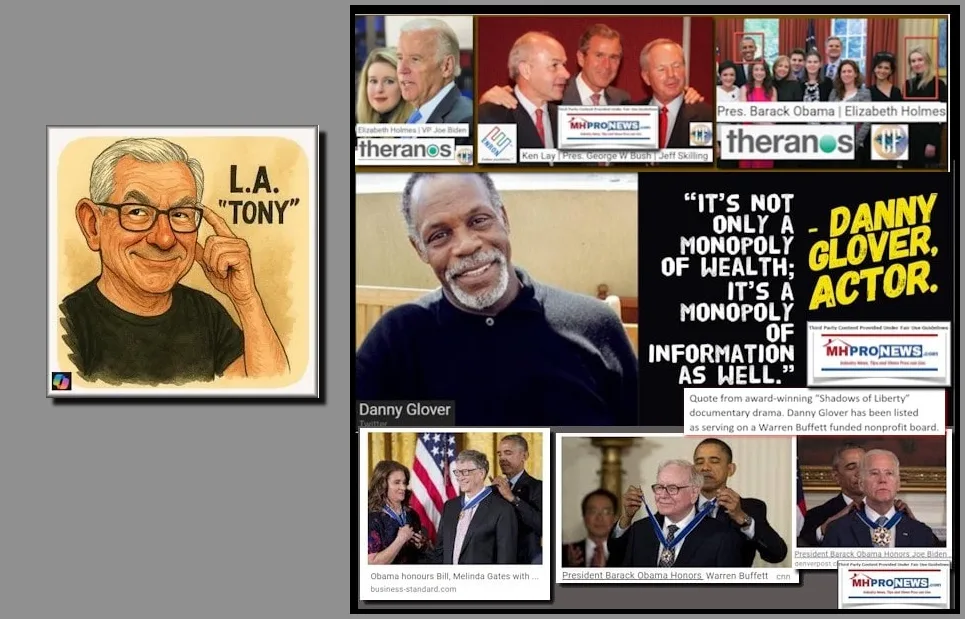
Per actor, activist and nonprofit board member Danny Glover: “It’s not only a monopoly of wealth; it’s a monopoly of information as well.” The photo collage linked here shows the bipartisan nature of the problem. Before progressing, let’s note that quoting a source doesn’t imply agreement with everything that source ever said or did. A good quote grounded in facts, evidence and reality can be useful regardless of race, gender, religion or political persuasion.
Once the “Check your facts” and “Follow the money” lessons taught by Sharyl Attkisson in her Tedx Talk are grasped, understanding our town, county, state, nation, or world begins to look different.
Right or wrong, some 70 percent of the population believe the ‘system is rigged.’
Some assert affordable housing is an ‘industrial complex’ that is part of a rigged system benefiting a few.
Antitrust law enforcement (anti-monopolization laws meant to protect competition) are touted by some. But what happens after elections are over? For decades, often not much. Power becomes more concentrated.
These aren’t reasons to skip voting. They’re reasons for ballot access reform and more engagement in the two major parties during primary season when candidates are selected. When two imperfect options are on the ballot, wise voters pick the better option.
Among the lessons from Shadows is the need for more solid local news outlets, like the Gazette. Per Pew, local media is more trusted. More to come, stay tuned.