By L. A. “Tony” Kovach
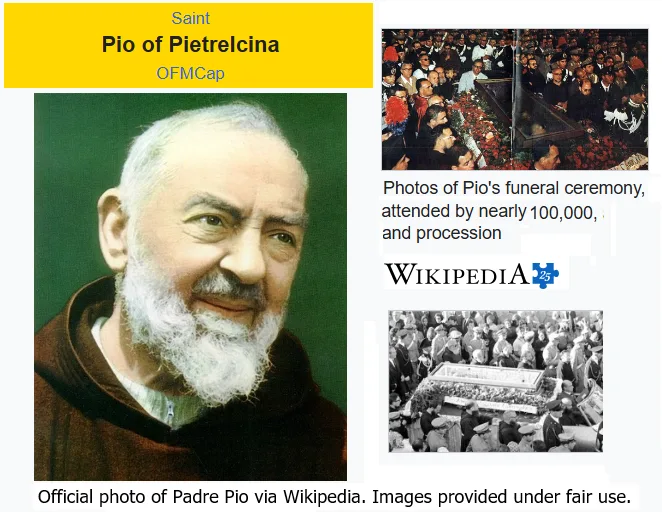
According to RCCLakeland.org: “Relics of St. Padre Pio Tuesday and Wednesday, November 10–11, 2026, at Resurrection.” But what are relics? Who is Padre Pio? Why might this matter in our times? Let’s look at those topics.
According to left-leaning Wikipedia: “Padre Pio was known throughout his life for numerous instances of supernatural phenomena, most notably stigmata—wounds like those of Jesus Christ at his crucifixion—on his hands and feet and side. Several investigations into the phenomena were conducted by the Vatican, and although they led to temporary sanctions on his ministry, his reputation for sanctity continued to increase during his lifetime. He was also renowned for other mystical phenomena, and many other forms of spiritual outreach to individuals. After his death, devotion to Padre Pio has continued to spread among believers worldwide…”
Wikipedia also states: “His relics are exposed in the sanctuary of Saint Pio of Pietrelcina, next to the monastery of San Giovanni Rotondo, which is now a major pilgrimage site.[4]“
According to the definition supplied by Merriam Webster, a relic is defined as: “an object esteemed and venerated because of association with a saint or martyr.”
According to RCCLakeland.org: “The relics of St. Padre Pio come to Resurrection for two days. Doors open at 2 PM both days for veneration, with a bilingual Mass at 6:30 PM and a final blessing at 9 PM. All are welcome, and there is no charge.” “Talk-Joseph Santoro: Tuesday 7:30 PM, after Mass · Wednesday 6 PM, before Mass.” More details are provided at the special RCCLakeland.org page established for this event, found here. FWIW, yours truly and my family and I plan to attend the talk on Wednesday. While all are welcome, free, non-Catholics that attend Mass may get a blessing, but should not take Communion unless they are practicing Catholics.
Why might the relics of Saint Padre Pio being in Lakeland, FL for two days matter? There is a clash of beliefs and practices in our era.
For instance, socialists, Marxists, and communists are routinely anti-religion.
According to left-leaning Wikipedia: “19th-century German philosopher Karl Marx, the founder and primary theorist of Marxism, viewed religion as “the soul of soulless conditions” or the “opium of the people“. He believed religion survives because of oppressive social conditions. When this oppressive and exploitative condition is destroyed, religion will become unnecessary, according to Marx.”
Also, per Wikipedia: “A number of Marxist-Leninist governments in the 20th century, such as the Soviet Union after Vladimir Lenin and the People’s Republic of China headed by Mao Zedong, implemented state atheism to allow the “opium” to be decentralized in secular civics, in line with post-theism.”
From Wikipedia: “Marx wrote. The abolition of religion as “illusory happiness” would lead to real happiness, he said — but only if people were freed from oppressive material conditions.[4]” “Lenin repeated that religion is the “opium of the people” and emphasized that religion and its institutions are instruments of the ruling class.[3]”
Socialism, Marxism and Communism are stated enemies of religious belief. While atheism and agnosticism have been more or less rising in the U.S. for decades, still some 70 percent of the U.S. are self-proclaimed Judeo-Christian believers.
For nonbelievers, skeptics, or followers of socialist and its related thinking, the relics of Padre Pio ought to raise questions. Does God exist? Is there evidence to support belief? Padre Pio’s relics are a reminder that there is evidence in our era for events that can’t be explained by science. Photos and videos of Padre Pio are available. Medical and scientific studies of signs and wonders associated with Pio are available to be studied.
Pio wasn’t a wealthy mega-church guy; he lived a life of self-imposed poverty for the sake of the Gospel of Jesus Christ. While Pio’s health was poor, he was associated with numbers of miracles and wonders that benefited others.
Also, regarding relics. The Bible contains several accounts where physical objects, clothing, or human remains were associated with miraculous events or divine power. Examples include:
- Elisha’s Bones (Old Testament): In 2 Kings 13:21, a dead man is thrown into the grave of the prophet Elisha; upon touching Elisha’s bones, the man revives and stands up. [1, 2]
- The Woman Touching Jesus’s Cloak: In Matthew 14:35–36 (and Mark 5), a woman with a hemorrhage is healed immediately after touching the tassel of Jesus’s garment. [1, 2]
- Paul’s Handkerchiefs and Aprons: In Acts 19:11–12, handkerchiefs and aprons that had touched Paul’s body are carried to the ill, resulting in healings and the departure of evil spirits. [1, 2]
Are there documented modern miracles and wonders? Yes. Padre Pio’s relics are among them and come into sharp contrast with the often anti-Christian and anti-religious beliefs of some.
The Creator of the Universe gave humanity free will. There is evidence for belief besides thousands of years of historical practice and evidence. Let’s close on the note that it has been said that the best argument against Christianity is Christians. Meaning, the bad behavior of this or that person is used to argue against Christianity or religious belief. Yet Jesus himself selected 12 apostles. One betrayed him, ten fled before his crucifixion and only one – young John – stood under the Cross with the Marys.
Perhaps some venerate Marx, Lenin, Stalin, Mao or Castro and their kindred spirits – but for me and mine, we are drawn to Christianity and Jesus and not by socialism, Marxism or Communism. ##
By L. A. “Tony” Kovach, publisher and co-founder of MHProNews, MHLivingNews, HousingWire contributor and previous op-eds via the Lakeland Gazette here.