By Saga Stevin, Floridian Future
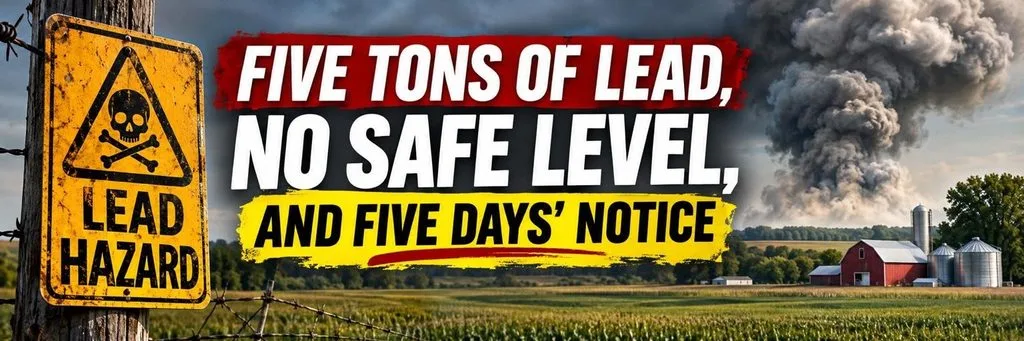
It’s real, and it’s on for tomorrow morning – Nov 25, 2026 – 68 barrels, roughly 9,500 pounds of degraded lead azide, at the Iowa Army Ammunition Plant in Middletown – and the chemistry is the problem.
The Army detonates 68 barrels of degraded lead azide at the Iowa Army Ammunition Plant on Wednesday morning – 6,700 pounds of lead, over the most productive farmland in the state, under a permit nobody had a chance to comment on.
The operation
At approximately midday Wednesday, explosive ordnance disposal teams at the Iowa Army Ammunition Plant in Middletown will fire two rapid detonations inside earth-covered concrete magazines ringed by two-story sand-filled HESCO barriers. The soil above will be saturated with water; misters will run throughout. The target is 68 barrels – nearly five tons – of lead azide, a primary explosive used to initiate munitions, stored for more than two decades in a water-and-ethanol solution that shifted over time and allowed the material to recrystallize. Recrystallized lead azide becomes sensitive to shock, friction and temperature. It cannot be moved, and the Army’s position is that it cannot be chemically neutralized without a fatal detonation during handling.
That is a genuine hazard, and it is the reason the operation carries the legal cover it does: an EPA emergency permit under RCRA, effective November 13, that bypassed the normal comment period. A federal appeals court lifted a temporary stay Monday and let it proceed, reasoning that an uncontrolled explosion would be worse. Trump ordered a pause until the court and Governor-elect Rob Sand signed off; the Army announced it was moving forward anyway, in coordination with state and local authorities. The original date was November 20. Residents learned of it five days out.
The plume and the fallout
Lead does not burn, whatever the reassurance about the material being “incinerated” implies. Lead azide is roughly 71 percent lead by mass, so the barrels contain on the order of 6,700 pounds of lead. Detonation temperatures are hot enough to vaporize a fraction of it into lead fume, which condenses as lead oxide particles small enough to travel deep into the lung and into the bloodstream – the most biologically available form of the metal. Nitrogen oxides and carbon monoxide come with it.
Coarse fragments drop near the magazines. The fine fraction is the problem: Army modeling has the deposition running northeast over farmland toward West Burlington and Burlington, with dispersal cited as far as 100 miles into Illinois, and dust lingering up to an hour. The number that determines everything – how much of that tonnage actually becomes airborne, the emission factor – has not been published. As University of Iowa environmental health professor Patrick O’Shaughnessy put it, in an ordinary air pollution case you know how many pounds per second leave the stack; here, “we have no idea.”
Fallout is a deposition problem more than an air problem. The particles that matter settle on roofs, vehicles, cisterns, playgrounds, garden soil, hay bales, stock tanks and pasture. The Army has accepted a cleanup obligation for off-site soil that exceeds EPA regional screening levels for lead, and has committed to sampling within 24 hours and publishing a final deposition map. What it cannot do is un-ring the bell for anyone whose well, pond or child got dusted before the testing caught up.
The farms underneath it
This is cattle and row-crop country. Thousands of acres inside and around the plant are leased to working farmers, and the deposition path runs over exactly that ground. Ruminants are among the most lead-sensitive animals there are.
Acute poisoning shows within days: sudden death, cortical blindness, head pressing, staggering, muscle tremors, teeth grinding, increased vocalization, seizures, loss of appetite. Chronic exposure grinds differently – poor weight gain, anemia, lethargy, visual impairment, reproductive failure. Standing pond water is far more dangerous than a flowing creek, because the metal concentrates and settles instead of moving on. Hay and silage stored outdoors take dust directly and deliver it to the bunk at feeding time.
Iowa State’s beef and pork centers, and the state agriculture department, have issued guidance: move animals out of the deposition zone or indoors under a roof, shut ventilation fans, cover feed, hay and water tanks or move them inside, keep animals in until the plume passes, then power-wash feeders, fencing, tanks, trailers and equipment. One Sperry farmer with more than 70 cows described his plan as tarps over the pole barn openings – gaps at the top and sides- and no way to seal it. He was told to buy a Tyvek suit, a respirator, and a leaf blower to clean his own hay. Schools in the path cancelled classes. No one has yet answered the residue question: what happens to the milk and the meat.
Take baseline samples now
This is the only task with a hard deadline, and it is the difference between a claim and a shrug. Ask the Army in writing for pre- and post-detonation soil and forage sampling on your property, and keep the paper trail if it declines.
Doing it yourself, properly:
Tools: stainless trowel or plastic scoop, clean bucket, zip-top bags. No galvanized or painted tools.
Soil: top 6 inches, 5–10 subsamples per field in a zigzag pattern, mixed in the bucket, about a cup per composite.
Forage and feed: grab samples from multiple bales, plus silage and any stored grain.
Water: pond and stock tank samples in clean glass or lab-supplied bottles; separate creek sample.
Surfaces: window sills, vehicle hoods, play structures, garden beds.
Labeling: field name, depth, GPS coordinates, date, time, wind direction. Photograph each bag and each sampling location.
Storage: double-bag, keep cool and dark, freeze or refrigerate, ship to an accredited lab for lead by EPA metals methods.
Repeat the identical protocol after the dust settles, and again after spring thaw and after any rain event that moves soil.
A documented spike is your evidence — for cleanup, for liability, for a vet’s diagnosis, for a lawyer. Rain, tillage and time erase the comparison otherwise.
What prompted it, and what the record actually shows
The stated trigger is a March safety review that found the deteriorated stockpile, and an Army determination that in-place detonation was the only option after chemical neutralization, thermal treatment, transport and leaving it alone were all rejected. The Army had already contracted a firm, MuniRem Environmental, to neutralize the material chemically; the contract was terminated two months later without a stated reason. That gap deserves a congressional answer.
The other standing question is why a plant that the Defense Department was publicly worried about in 2004 – a Picatinny Arsenal article from 2014 describes a green-primary-explosives program begun in response to “a 40-year-old stockpile of lead azide deteriorating at the Iowa Army Ammunition Plant” – produced a public emergency in 2026 with five days’ notice.
The data-center theory is the one circulating hardest, and on the documents it does not hold: the nearby modular Bitcoin mining site was under construction by the end of March, before the lead azide was public, and no Army, EPA, state or court record names the companies involved. What the record does show is the pattern people are reacting to. Two large projects landed on one small county in one year, residents found out about both after the decisions were made, and the same board of supervisors that was drafting data-center zoning voted to deny a right-of-entry request for lead sampling tied to the plant.
The bottom line
The blast itself is not the main risk – a controlled detonation inside a bunker is a known quantity. The risk is the dust nobody measured, the agricultural products nobody is testing, and the baseline nobody took. If you live or farm under that plume, the sampling you do today is worth more than every assurance you’ll be given tomorrow.
This is general information, not advice for your specific situation – work with your veterinarian, county extension office, and an accredited laboratory.