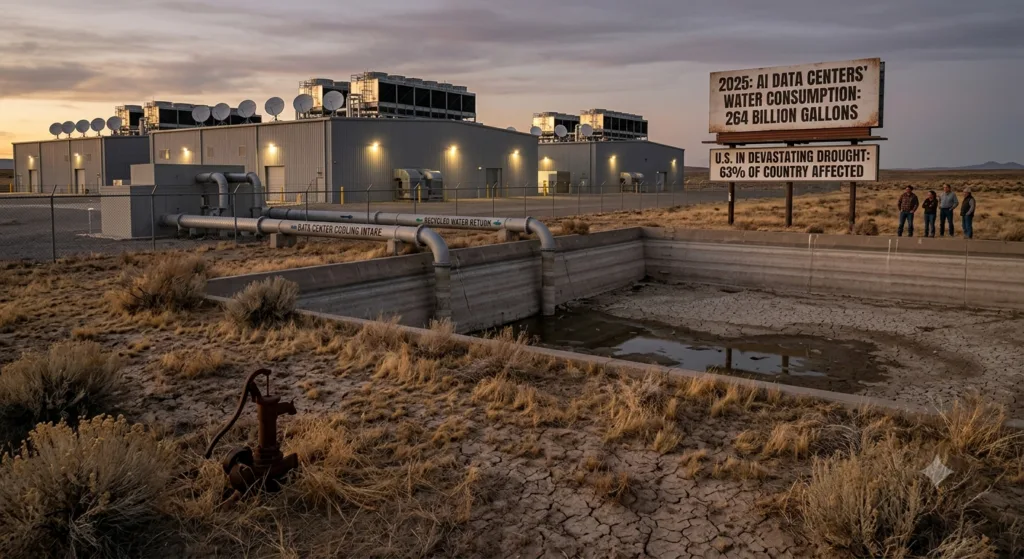
The reality of AI’s physical footprint is hitting a massive bottle-neck. The intersection of skyrocketing tech infrastructure and severe environmental strain is no longer a future prediction—it’s happening right now.
Here is a breakdown of what is driving this crunch:
The “Hidden Thirst” of Artificial Intelligence
While AI exists virtually to us, it relies on millions of physical servers packed with heavy-duty graphics processing units (GPUs) that generate incredible amounts of heat.
- The Consumption: In 2025 alone, AI data centers consumed nearly 1 trillion liters (264 billion gallons) of water. That is roughly 550 million gallons a day—matching the daily output of the entire global bottled water industry.
- The Culprit: Most large-scale “hyperscale” data centers rely on evaporative cooling systems. To prevent the processors from overheating, water is evaporated to cool the air inside the facility.
- The Individual Toll: Researchers estimate that a standard 100-word AI prompt interaction can consume roughly a $500\text{ mL}$ bottle of water when accounting for the total cooling loop.
The Clashing Realities: AI vs. The US Grid
The problem isn’t just how much water is being used, but where it is being drawn from:
| The Crisis Factor | The Impact on Communities |
| Severe Drought Footprint | Close to 63% of the U.S. is facing severe drought conditions. Paradoxically, nearly two-thirds of upcoming U.S. data centers are slated to be built on this exact drought-hit land. |
| Local Strain | A single massive data center can consume up to 5 million gallons of water a day—the equivalent footprint of a city of 50,000 people—placing immense strain on shared municipal aquifers and reservoirs. |
| The Double Whammy | Beyond water, these facilities are requiring massive energy grid expansions. In places like Tennessee (a growing AI hub for projects like Elon Musk’s xAI) and Georgia, utilities are rushing to add capacity, sparking fierce local backlash over fears that ordinary residents will foot the bill via higher utility rates. |
The Moving Target
Tech giants (like Microsoft, Google, Meta, and Amazon) have pledged major “water stewardship” goals to replenish more water than they consume by 2030. However, the sheer speed of the AI gold rush is outrunning infrastructure adaptation. Furthermore, recent UN reports point out that the data center buildings themselves are only 4% of the issue—the power plants built to run them and the semiconductor plants manufacturing the chips use trillions of gallons more.