By L. A. “Tony” Kovach
Like it or not, the law of supply and demand is at work everywhere in the U.S., including at land-lease manufactured housing communities (MHC). What are often called ‘trailer parks’ or ‘mobile home parks’ may more accurately be called manufactured home communities (MHCs), because there have been no new ‘mobile homes’ built in the U.S.A. for over 50 years. Let’s briefly focus on the causes and cures for commonly reported (and correctly so) concerns about the often-stiff hikes of ‘lot rents’ in MHCs.
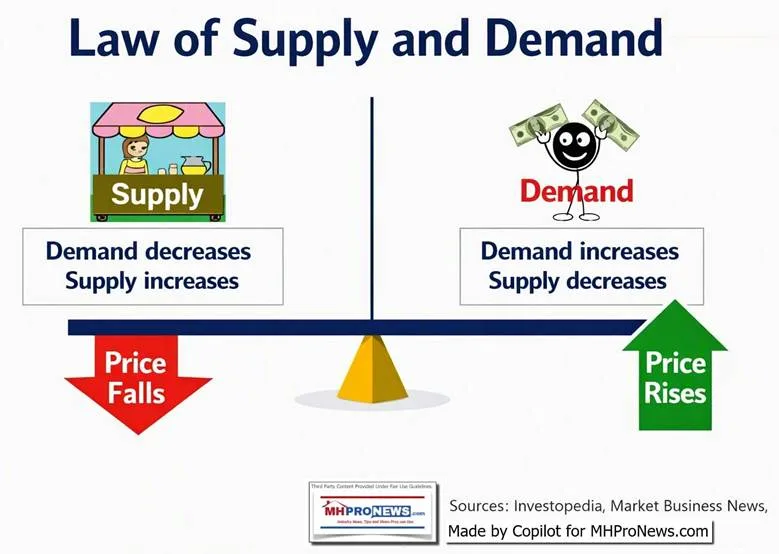
As MHC resident-advocate Tim Sheahan aptly said in testimony to the FHFA: “I have been a volunteer homeowner advocate for over 20 years serving at the local, state and national level…” Sheahan said he witnessed “the best of manufactured housing done right” and “manufactured housing done extremely wrong.” Per Sheahan: “my city of San Marcos had a population of less than 4,000 and was part of the dramatic manufactured housing community development boom of the 1970s, adding over 3,000 pads among 18 manufactured home communities, which led to more than a doubling of the population by the mid 1970s.” Some key points (bold added) from Sheahan: “Initially, stiff competition among various developers during the only time a true “free market” situation existed in these communities commonly led to very reasonable starting rents. In fact, I’ve been told that in my community, which happened to be developed by actor Ray Bolger, from The Wizard of Oz movie, and his partners, lot rents were $50/per month, as was often the case in other MH communities in the area. As the communities filled with “im-mobile” homes, free market forces such as competition were lost and lot rents for captive homeowners skyrocketed in many areas.” That in a nutshell is the law of supply and demand at work in MHCs.
Less new competition equaled higher lot rents.
When zoning makes it difficult to develop new land lease communities easily, properly and with lower costs, an array of smaller (including mom and pop) operations can’t develop a ‘park’ (MHC). When developing becomes rare due in part to zoning/regulatory barriers and local resistance, those who already have an MHC have what amounts to a localized monopoly.
Frank Rolfe and his partner Dave Reynolds have been Manufactured Housing Institute (MHI) members for years (example: MHP Funds and MHBay). Quoting Rolfe doesn’t imply agreeing with him. We’ve been routine critics of his business practices. That said, understanding how they (and others who are often MHI members) operate is necessary. Quoting Rolfe on ‘Why You Should Never Build a Mobile Home Park.’
“If you like having a monopoly, holding all the cards, knowing the tenants won’t move their homes out, never worrying about someone building a new property near you and taking one of the tenant’s biggest assets if they default, then you’re going to love mobile home parks.”
Rolfe doesn’t hide it, he celebrates it. The bold was added. As a result of such local monopolies, Rolfe and Reynolds could boldly say: “Push Rents Relentlessly.”
While the communications style of Rolfe and giant Equity LifeStyle Properties (ELS) are different, ELS said similarly in their investor relations pitch. Quoting ELS doesn’t imply endorsing their business model. These quotes are for understanding purposes. Per ELS.
“Supply Constrained Asset Class“
- “There has been limited MH development in the U.S. in the past 20 years”
- “Growing demand couple with almost no new supply is a strategic advantage for ELS”
Under “Reasons for the Supply Constraint“
- NIMBY [Not in my back yard]
- Restricted zoning & regulations
By restraining new MHC development (potential new supply) the inevitable result is less competition and higher site fees (‘lot rents’).
There is an amended national class action antitrust (anti-monopolization) suit (Case #1:23-cv-06715) currently underway in which 8 of the 11 original defendants were MHI members. Murex Properties, which has a Polk County MHC, has offered to settle. The case is pending a motion to dismiss by defendants.
As resident/advocate Sheahan and others pointed out, so-called “resident owned communities” (ROCs) routinely have lower lot rents and happier residents.
MHI gave “excellence” awards to a MHC operator with an “F” Better Business Bureau (BBB) rating and to a ‘predatory’ defendant in the class action antitrust case.
MHI has been slamming ROCs in testimony to states, even though ROCs keep land-lease more affordable. So MHI, despite their so-called ‘code of ethical conduct‘ which cautions members against creating negative publicity that harms the industry, duplicitously protects the image of ‘predatory’ MHC members.
Restated, MHI has arguably been attacking ‘white hat’ ROCs while defending the image of purported ‘black hat’ predatory firms.
Part of the solution is to allow the free market and good federal laws to work. Allowing more development of communities and privately owned sites could keep costs in line. Meaning, by enforcing existing laws, as the Manufactured Housing Association for Regulatory Reform (MHARR) has advocated for years, prices for leased lots could stabilize or fall. Housing affordability would spread.
There is more to know on these issues, see here and here. More insights into consolidation, affordability and possible solutions are planned for the days ahead. Stay tuned.